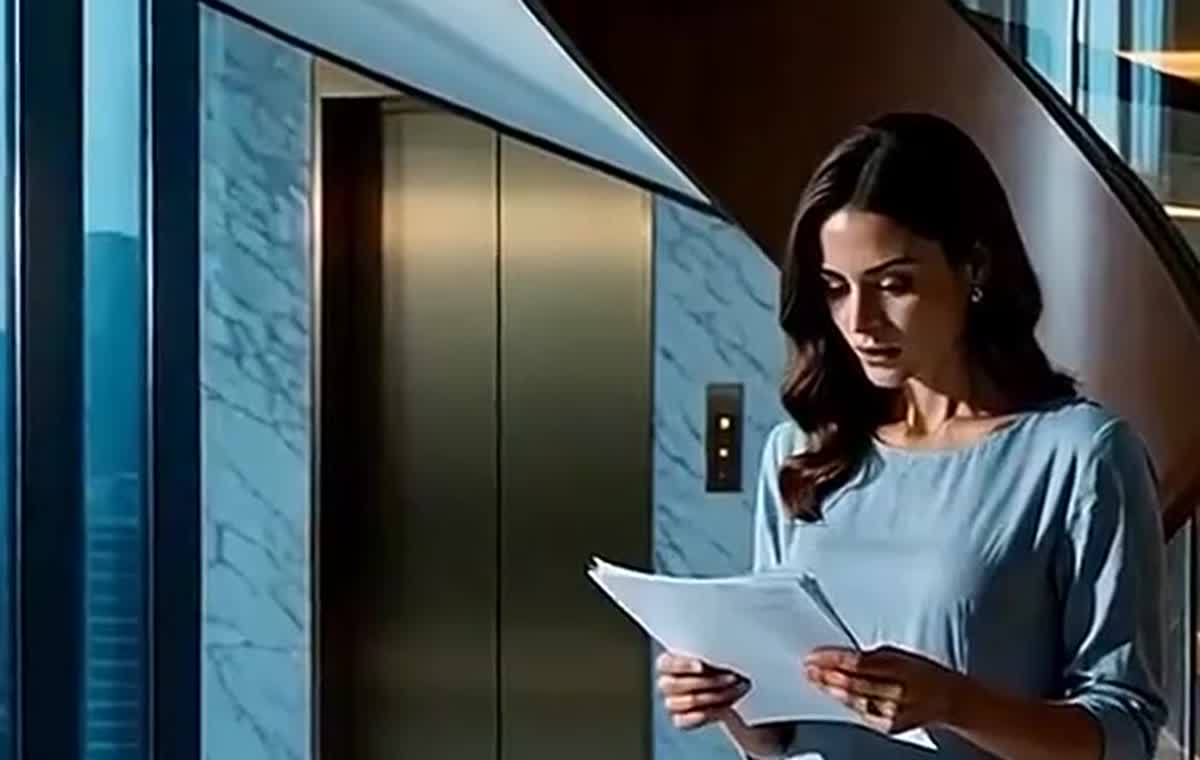
Episode 9. A woman comes home, walks straight into the living room, and finds her husband sitting across from a lawyer. She does not knock. She does not reach for a key. The door was already open, and the camera was already inside, waiting for her.
In the last eleven series I watched I counted four knocks. Four, across something like nine hundred episodes. In the same nine hundred episodes I counted more than sixty scenes that start with somebody walking into a room where somebody else is having a private conversation.
That is not laziness. It is arithmetic, and it is one of the few structural choices in this genre I think is genuinely clever even when it looks like a mistake.
A door is a cut, not a wall
A ninety-second scene cannot spend three seconds on a handle. You get maybe two establishing frames before dialogue has to start, because the first line is what stops the thumb. If she has to fish a key out of her bag, the viewer has already decided whether to keep watching, and nobody wants that decision happening in a hallway.
So the door is pre-opened. Not open enough to be a plot point, just open enough that a hand can push it and the shot continues.
The open door is how the plot gets in
Every important piece of information in these shows arrives by accident. The overheard sentence. The document left face up on the desk. The phone call taken two metres from the person who definitely should not hear it. A closed door would shut down the entire information economy of the genre, so the door is never closed and the wall is never quite a wall.
Glass instead of walls
The chairman's office has a glass wall. The hospital room has a window onto the corridor. The restaurant has a partition you can see through. That is not a design trend, it is a framing solution: in a frame this narrow you cannot cut between two rooms without losing the face you just introduced, so the set quietly loses a wall instead of the editor losing a shot.
Locks would require a world
A lock implies a key. A key implies whoever issues it, a building with a manager, and a legal right to be inside. That is four extra pieces of world for one second of screen time. So hotel rooms open, hospital wards open, and the family mansion worth nine figures has no security at all. The missing locks are the missing institutions, which is also why nobody ever calls the police and every deal in these shows gets settled in cash.
The slam is one of the three sound effects
They do slam doors. The slam is the punctuation mark, the only way this genre ends a scene without a fade, and it is almost always the same recording, because it was captured once and never replaced. Functionally the door is a gong. Somebody leaves, the gong sounds, we are in the next scene, and the plot has moved whether or not anybody earned it.
Once I started counting I stopped being annoyed. A locked door would mean a scene about logistics, and there are ninety seconds and one betrayal to get through. The open door is simply the fastest way to put two people in the same frame and let the worst possible thing happen between them.
If you want to check the theory, the ten-second preview is here. If the app is already on your phone, the search code 5626185 opens the series directly.
I write about vertical series for Yunxun Drama. Nothing here is sponsored by any app; the preview link is my own affiliate link and the platform pays me a small commission if you install through it.